
Podcast
IRS Bypassing The POA?
June 4, 2026
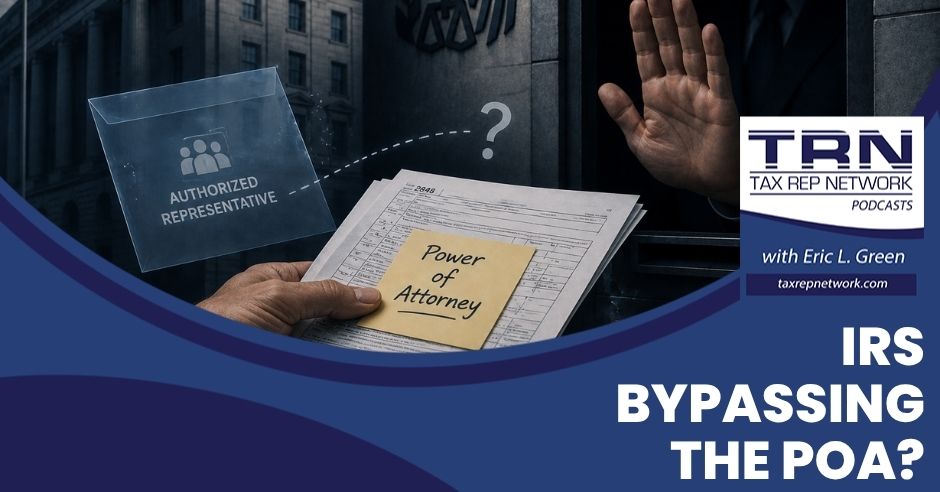 Can the IRS just ignore the taxpayer's Power of Attorney (POA) and contact the taxpayer directly? No, unless specific criteria are met. In this week's episode, Eric Green discusses why that threat from the IRS employee is probably empty, and what to do if they do in case they bypass you and go directly to your client.
---
Watch the episode here
Listen to the podcast here
IRS Bypassing The POA?
Why The IRS Cannot Just Ignore The Taxpayer's Representative
It is just me. I wanted to address something. This has come up with a couple of my tax rep members. We are experiencing this very strange attitude from the IRS, where they may decide, "Mr. or Ms. Power of Attorney, I am going to ignore you," and they are literally just bypassing or attempting to bypass the power of attorney, contacting the taxpayer directly. I have gotten a lot of questions like, “Can they do that?” They are supposed to have supervisory approval, where you, as the holder of the power of attorney, are not being responsive. They cannot be held hostage to a power of attorney that ignores them, delaying things. They can get supervisory approval to bypass you, but only in that circumstance. Otherwise, the IRS auditor or the IRS collection folks are required to contact the power of attorney. If you are wondering, "Eric, are you sure about that?" On the collection side, it is code section 6304. It basically says, “Without the prior consent of the taxpayer given directly to the secretary, meaning the IRS, or the express permission of a court of competent jurisdiction, the secretary may not communicate with a taxpayer in connection with the collection of any unpaid tax if the secretary knows the taxpayer is represented by any person authorized to practice before the Internal Revenue Service with respect to such unpaid tax or has knowledge thereof.” If they know that you have a power of attorney on the collection side, the federal statute basically says the Secretary of the Treasury, IRS, and everyone under them cannot ignore a power of attorney. On the audit side, in the Internal Revenue Manual, it is section 4.11.55.2. That states that a valid power of attorney submitted by a taxpayer must be recognized unless the bypass criteria have been met and implemented. It also states that taxpayers have the right to their representative being present whenever they are interviewed or asked to furnish information. [bctt tweet="If the IRS knows that you have a Power of Attorney on the collection side, the federal statute basically says the Secretary of the Treasury, the IRS, and everyone under them cannot ignore it." via="no"]Why The IRS Cannot Bypass Your POA
Bypass criteria is what I talked about, where you are not responsive, or you are delaying and running a delaying action on the government. I just wanted to take this opportunity to very quickly explain why the IRS cannot just bypass you. If you are finding that that is happening, let us say it is an auditor, and I always do this in writing, I would send a certified letter or FedEx, depending if it is a street address, and I would fax them. You want it in the IRS system, and their e-faxes are all logged to that auditor saying, "Enclosed is another copy of my power of attorney, which I did give to you on such and such location, such and such date. I just want to make it clear, you are contacting the taxpayer without contacting me first, in contravention of your own Internal Revenue Manual.” “IRM 4.11.55.2 states that with a valid POA, you are supposed to come through me. I am going to ask you one more time, please do not contact the taxpayer directly. Contact me, and we will get you whatever information you need. If you disagree with this, please have your supervisor contact me and explain why you believe that you do not need to deal with me.” On the collection side, I would cite the same thing. The collection statement is IRM 5.1.23.6. It explains what I read to you before, Code Section 6304 bars the IRS from communicating with a represented taxpayer in the collection of an unpaid tax unless the taxpayer or the authorized representative consents, or again, bypass criteria have been met, meaning that we are ignoring them, not responding, etc. If you are being responsive and they have your power of attorney, they should not be bypassing you. I would advise the client, “If you hear from them directly, do not say anything, basically, tell them to contact your power of attorney and hang up on them or shut the door in their face.” They have no right to actually bypass the power of attorney. There is a caveat to that. If criminal special agents show up at the front door, they are not going to wait for the representative to show up. What your client should do, if God forbid they are ever faced with special agents, is to inform them that they want to speak to their attorney, and if they want to leave their card, the taxpayer will have their attorney reach out to the special agents, but otherwise they have nothing to say to them, thank you very much, and shut the door.
If they have a search warrant, then you have to let them execute the search warrant. You will probably notice there will be two special agents who hang around with the taxpayer. They are waiting to see if the taxpayer starts saying things that are going to get them in trouble or maybe an admission. Your client really needs to learn to shut up. Do not say anything to the special agents.
Frankly, do not say anything to the revenue agent or revenue officer because I can tell you, whatever you say, they are not going to view you in a good light. They are going to try to twist it in a way that helps them. I had a family member actually get audited on their business. What happened is they had a consulting business. For the last several years, they were just winding down the business. The auditor bypassed me, went straight to them, and said, "Why do you not have any income these two years?"
What they said is, "We weren't really working at it anymore." What the auditor said is that the client has admitted it was a hobby. No, it was not. They had a very successful consulting business for ten years, but they are entitled to a two-year wind-down period, by the way, if you were not aware of that. I now end up in a huge fight with them and the supervisor. I basically said, "F*** you. Deny it, just let me go to appeals already. This is a waste of time."
By the way, I am actually going to try to move for sanctions because what you are doing is intentional. You are liars. Screw you. That is actually not a good approach. I cannot have them sanctioned, but I got really heated. It is not a good thing to do. Frankly, do not do what I did. In my telling them, "Screw you, let me go to appeals," they rethought their position, and we ended up settling it.
If criminal special agents show up at the front door, they are not going to wait for the representative to show up. What your client should do, if God forbid they are ever faced with special agents, is to inform them that they want to speak to their attorney, and if they want to leave their card, the taxpayer will have their attorney reach out to the special agents, but otherwise they have nothing to say to them, thank you very much, and shut the door.
If they have a search warrant, then you have to let them execute the search warrant. You will probably notice there will be two special agents who hang around with the taxpayer. They are waiting to see if the taxpayer starts saying things that are going to get them in trouble or maybe an admission. Your client really needs to learn to shut up. Do not say anything to the special agents.
Frankly, do not say anything to the revenue agent or revenue officer because I can tell you, whatever you say, they are not going to view you in a good light. They are going to try to twist it in a way that helps them. I had a family member actually get audited on their business. What happened is they had a consulting business. For the last several years, they were just winding down the business. The auditor bypassed me, went straight to them, and said, "Why do you not have any income these two years?"
What they said is, "We weren't really working at it anymore." What the auditor said is that the client has admitted it was a hobby. No, it was not. They had a very successful consulting business for ten years, but they are entitled to a two-year wind-down period, by the way, if you were not aware of that. I now end up in a huge fight with them and the supervisor. I basically said, "F*** you. Deny it, just let me go to appeals already. This is a waste of time."
By the way, I am actually going to try to move for sanctions because what you are doing is intentional. You are liars. Screw you. That is actually not a good approach. I cannot have them sanctioned, but I got really heated. It is not a good thing to do. Frankly, do not do what I did. In my telling them, "Screw you, let me go to appeals," they rethought their position, and we ended up settling it.